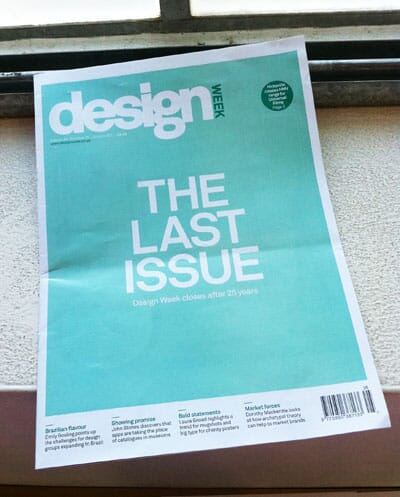
Two significant events took place in British design last week. Firstly, Habitat was sold to a holding company that owns two other UK retail brands Argos and Homebase, which almost certainly means the chain’s 30 stores outside London will disappear. Secondly, the UK’s weekly design trade magazine, Design Week, published its last issue.
Now that quality cheap furniture is readily available due to the rise of the likes of Ikea, Habitat’s demise was perhaps inevitable once it lost its USP. But for the industry to lose its ‘trade mag’ is a blow and leaves UK design without a significant independent voice.
Given that the staff were apparently only informed last Monday, a day or so before the final print run, there was little or no time to prepare a decent history of the magazine’s 25 years, other than for its long-running editor, Lynda Relph-Knight to pen a brief editorial and wish the remaining skeleton digital staff luck. It seems that the ‘magazine’ will continue to exist only in its online form, along with other closed titles such as New Media Age (part of publisher Centaur’s ‘restructuring’ of around 60 staff).
You’re left wondering who or what will now speak up for design in this country. The Design Council is in the midst of its own particular turmoil as it tries to re-engineer itself as a no-longer-beholden-to-government charity whilst incorporating parts of CABE (the Commission for Architecture and the Built Environment, scrapped in the recent quango review). D&AD has just appointed a new chief executive from the advertising industry and can never represent just the design side of the fence. And the Chartered Society of Designers (CSD)? Well, we’re still waiting for someone to explain exactly what they do.
So we’re writing this with heavy hearts – Relph-Knight and her team tracked the growth and development of countless design companies and trends (as did Jeremy Myerson before her). For better or for worse, UK design was reported on and discussed, and the magazine regularly found itself central to key industry debates.
There may be some who won’t mourn its passing. The last edition itself reveals many of its recurring tics - several pieces about not-very-interesting account wins from publicity hounds that have the fingerprints of ‘in-house PRs’ all over them. An article by an ‘industry expert’ that talks about their own work to illustrate their point (ie pretty close to self-promotion). The obligatory ad for an up-and-coming award scheme. Then, most tellingly, one single page of ads for design jobs. Without advertising, trade mags die, and with the economy stalled in the doldrums, this is probably why closure became inevitable.
As regards those with gripes about its content, perhaps some of it was justified, but producing a weekly magazine on one overall topic? That’s tough, and for all its flaws Design Week made a pretty decent stab at it.
Of course with the rise and rise of corporate and personal design blogs and the immediacy of twitter, there are just more ‘opportunities to see’ (and read) elsewhere now, and this is presumably where Centaur’s management team will hope the online version will come into its own. They will be using sister publication, Creative Review as a benchmark since CR seems to have managed to find a way for the printed and online versions to work in parallel, not fight each others’ content.
We’re told the awards schemes will continue, which itself is a sad indictment. It seems there’s more money to be made running awards for design than actually writing about it or analysing it. Celebration or critique? It seems Centaur has made an entirely fiscal decision on that one.
It’s not all bad, of course. At the top of the market, Eye magazine continues to provide an exceedingly high standard of design journalism and critique, and Grafik magazine has been reborn. But that traditional (and impressive) boast of the UK as the only country in the world with its own weekly design magazine? Well, that no longer applies.
By Michael Johnson